
• Exhibitions
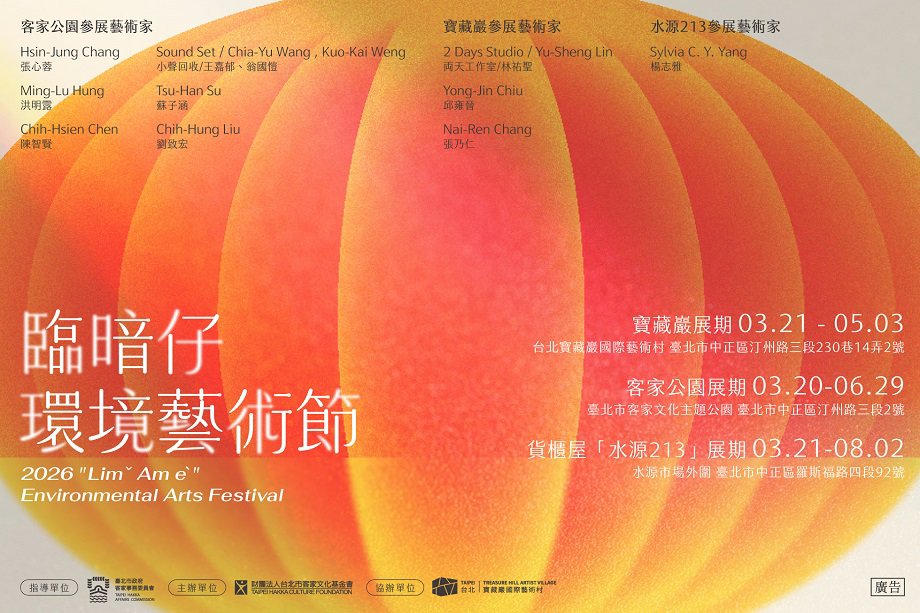
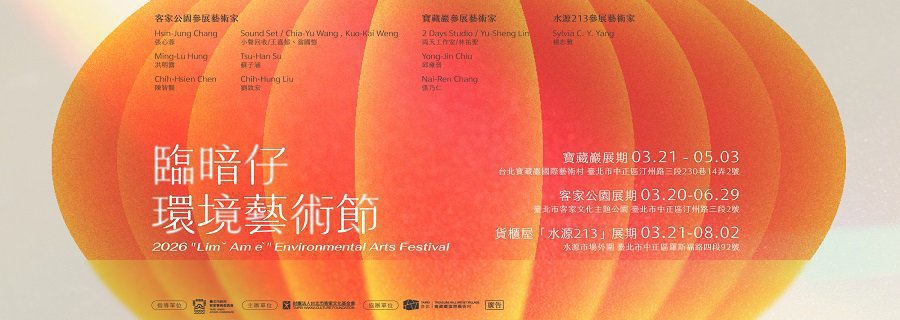
  • 2026 "Limˇ Am eˋ" Environmental Arts Festival
2026 "Limˇ Am eˋ" Environmental Arts Festival

Date:2026-03-20 ~ 2026-06-29

Venue:Taipei City Hakka Cultural Park

Organizer:Taipei Hakka Culture Foundation

The Taipei Hakka Culture Foundation has long been dedicated to promoting Hakka arts and culture. In 2026, it presents the 2026 “Limˇ Am eˋ” Environmental Arts Festival, inviting artists to explore the concept of the tangˇ (communal courtyard) as a core curatorial theme. Through environmental and light-based artworks, the festival responds to Hakka philosophies of everyday life and creates spaces for public dialogue.“Limˇ Am eˋ,” a Hakka term referring to dusk, symbolizes a liminal moment of transition between day and night, as well as cultural transformation. The festival is presented at Taipei City Hakka Cultural Park and Treasure Hill Artist Village, and is presented in connection with the Treasure Hill Light Festival, jointly shaping a distinctive twilight aesthetic in Taipei’s southern urban area.

Artwork at Taipei City Hakka Cultural Park

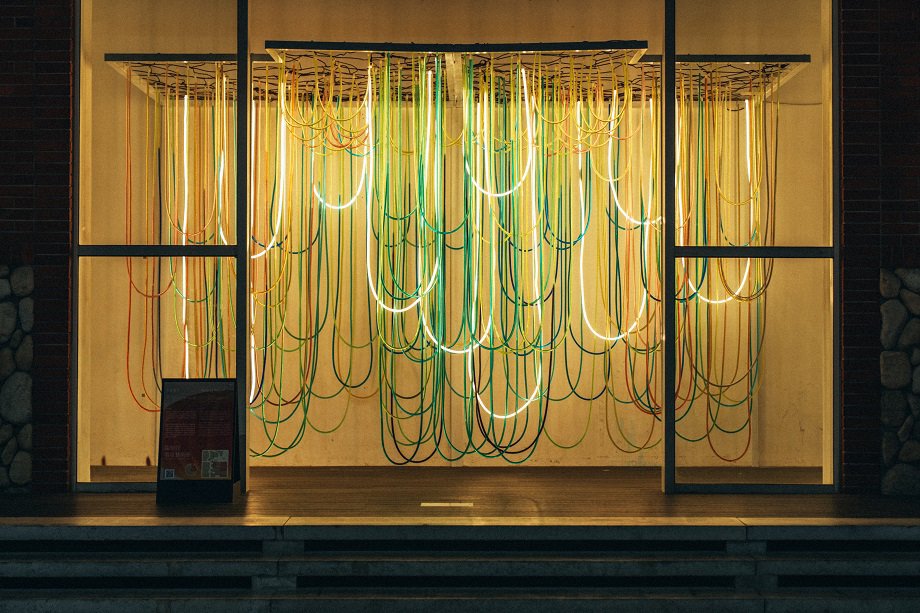
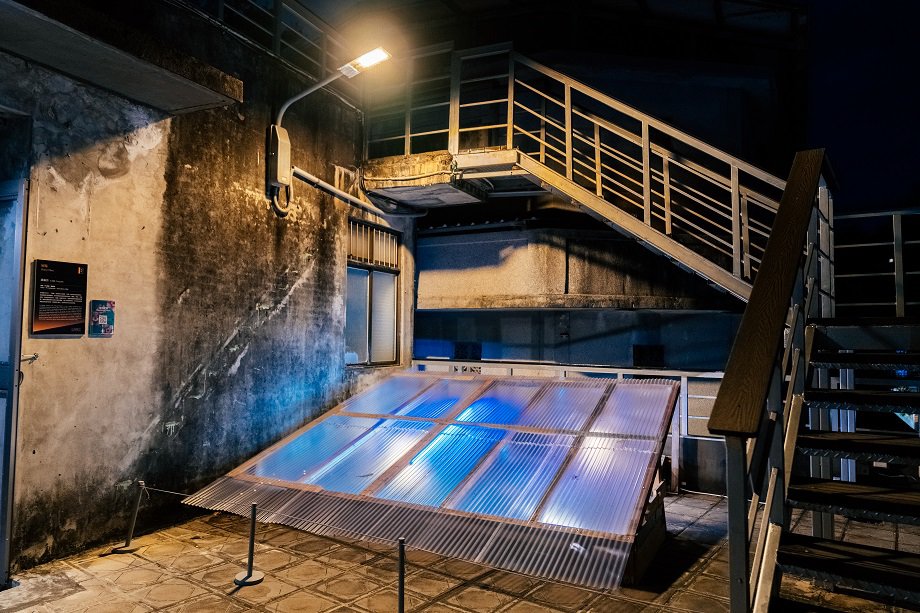
  • Hsin-Jung Chang, 《Held by Water》—At dusk, walking home along the river, the shifting light creates a sense of distance from the familiar landscape. The river is no longer merely flowing; it carries the colors reflected from the sky and the riverside greenery—briefly emerging and quietly dissolving with the current, forming a vista unique to the moment of " limˇ am "(臨暗).《Held by Water》captures the ephemeral colors and ambiance of the river. By using water pipes to "store" these fleeting moments, the artist transforms them into a visible and sensory existence. The installation invites the audience to pause and sense the magical transitions of water under different light conditions. It serves as a collective memory of water, time, and the act of walking—a dialogue with the Xindian River that resonates with the universal experience of encountering the water’s edge.

  • Ming-Lu Hung,《When the Mushrooms Come 》—The artwork appropriates the form of the 「mushroom」 as its central metaphor, grounding itself in the embodied wisdom and spiritual symbolism inherent to Hakka culture.Anchored to decaying wood and thriving in the quietude of damp shadows, the mushroom is a slow manifestation of time. Its existence demands a symbiotic patience, labor, and a submission to nature’s circadian rhythms. This biological process serves as an ontological mirror to the Hakka ethos—reflecting a resilience forged in frugality, endurance, and a grounded, steadfast approach to being.《When the Mushrooms Come 》Through a process of formal translation, this work materializes an ethos of understated resilience. It transcends the biological reality of plant and sustenance, sublimating them into a perceptible cultural phenomenology.The upward-thrusting umbrella structure suggests a potent force of growth persevering within constraints. Meanwhile, the rhythmic unfolding of its layers mirrors the sedimentation of generational memory and the physical traces of labor—ultimately proposing a re-examination of the Hakka spirit as a perpetual state of becoming in the contemporary era.

  • Chih-Hsien Chen, 《As the Wind Comes》— It centres on the Hakka notion of “limˇam”, the threshold moment when day slips into night. Here, wind becomes the trigger that shifts the state of light and shadow. Suspended within a dome-like space, translucent structures sway with the moving air, causing light to drift, overlap, and fade through the atmosphere. Light is no longer a fixed source of illumination. At dusk it is set in motion by wind and carried forward by time, forming a continuously changing field of perception. The work responds to the fleeting, fluid relationship between people and their environment, a brief encounter that is always in motion and never quite the same twice.

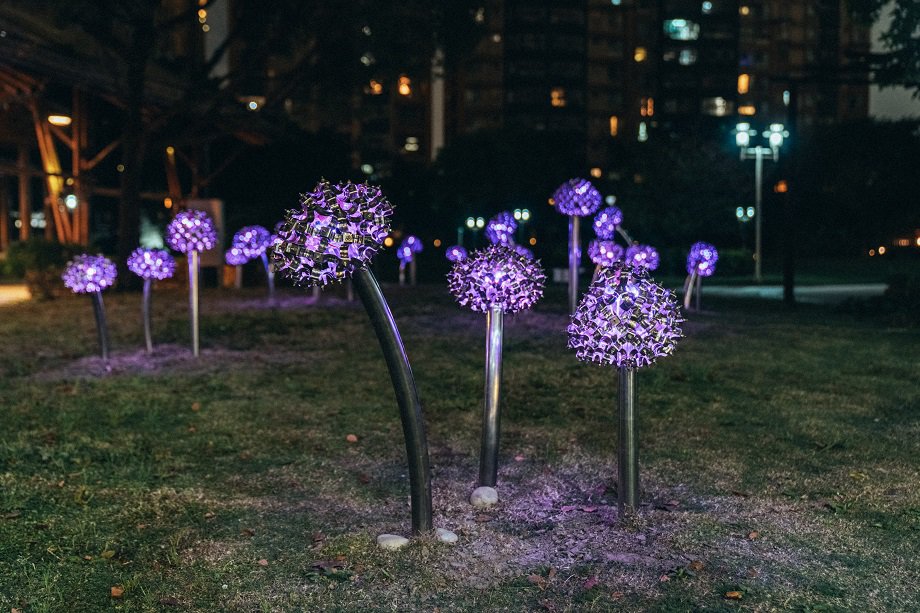
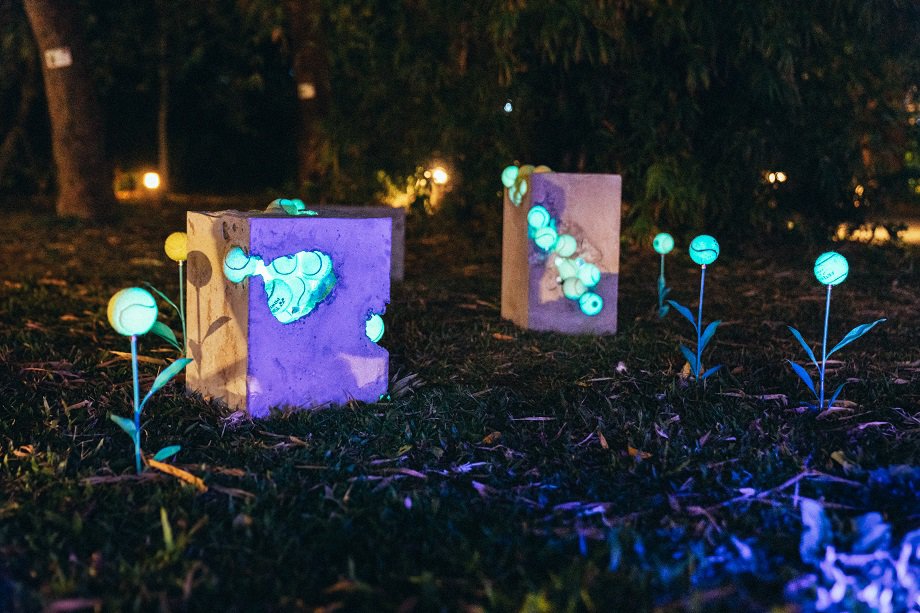
  • Sound Set / Chia-Yu Wang , Kuo-Kai Weng, 《Luminous Crevices》—This artwork repurposes discarded tennis balls that the team happened upon during part-time work. Embedded in cement, the fluorescent yellow spheres release a faint glow through their seams, softly illuminating tennis-ball forms that cluster across the grass like a small colony of plants. 《Luminous Crevices》 brings together dissimilar materials and a virtual, life-like mode of growth to evoke a transitional moment between stillness and emergence. It echoes the Hakka notion of dusk, the threshold where day gives way to night, while also reflecting a Hakka everyday ethic of extending the usable life of things. After nightfall, the work reads like a strange yet familiar organism, generating a heterogeneous landscape within the fissures of the city. The sculptures also function as seats, shaping a“miniature yard” on the lawn, and inviting visitors to pause, gather, and exchange words.

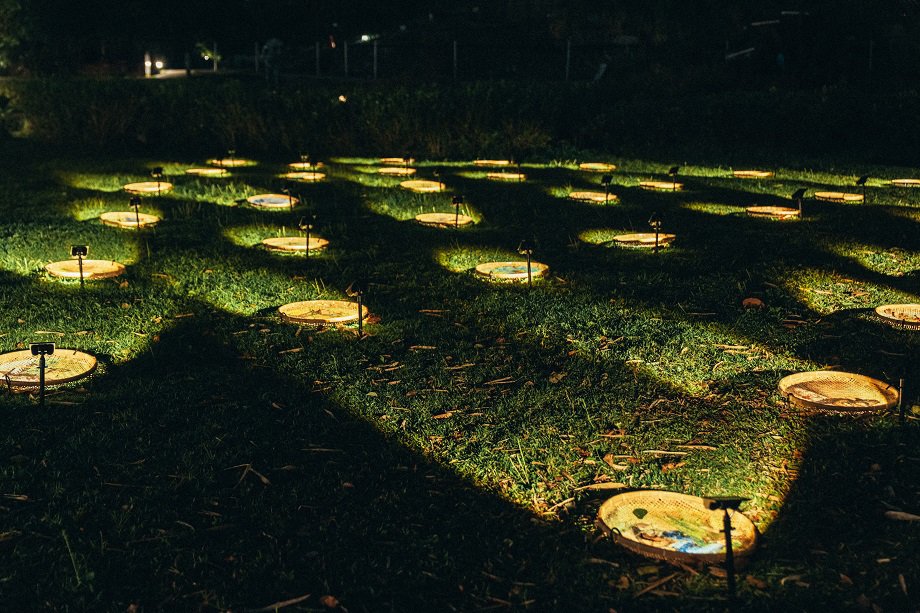
  • Tsu-Han Su, Dotted Starlight —《 Scattered Lights on the Ground》-This artwork takes light as a medium of time and memory, drawing upon the symbolic meanings of lantern festivals—blessing, gathering, and guidance—to transform these ideas into a luminous field that can be walked through, observed, and felt.The installation is scattered across a grassy landscape: during the day, the objects rest quietly on the ground like dormant vessels; at night, they illuminate one by one, resembling faint memories of light emerging at the edges of the city.

    The forms of the work are derived from traditional rural tools such as bamboo sieves and grain-drying baskets, once common in agricultural life. Their circular structures symbolize cycles, harvest, and the passage of time. Through the introduction of light, these objects—originally associated with labor and everyday routines—are reconfigured into vessels of illumination, carrying stories and memories, as if the land itself were softly responding to its past.

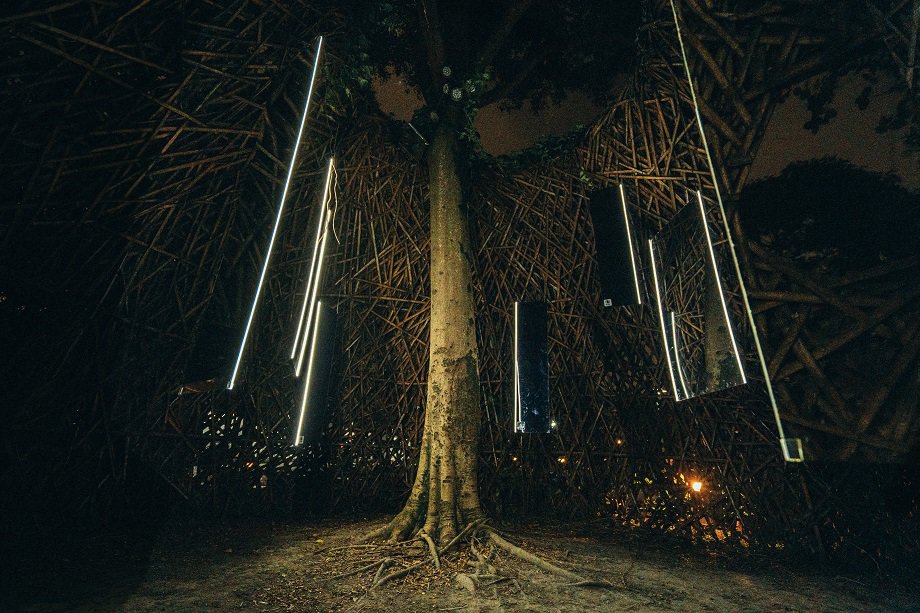
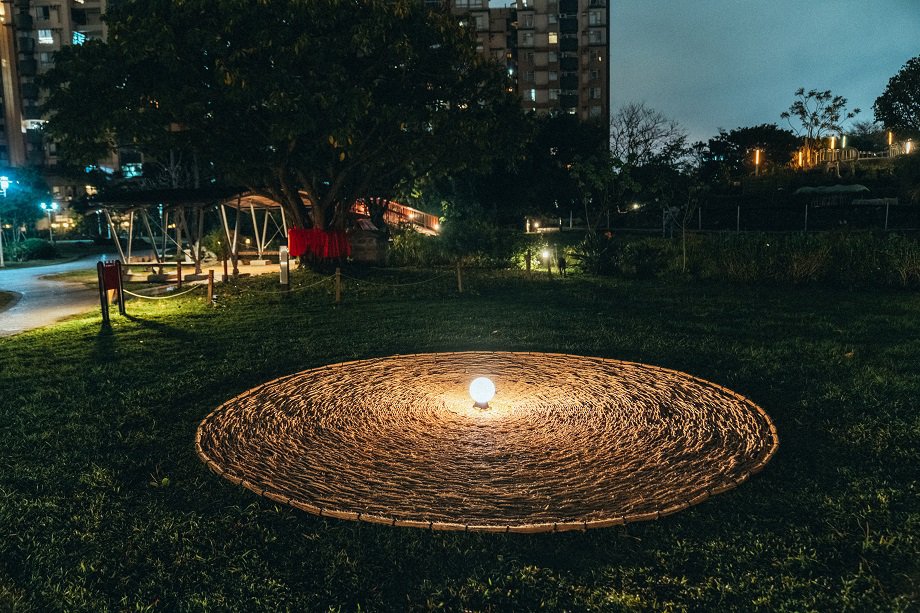
  • Chih-Hung Liu,《 Weaving Lights》— Beginning with childhood memories of the three-section compound house, this work looks back to the everyday landscapes of Hakka settlements, where life is closely bound to the land. A courtyard where rice and grain are laid out to dry, the seasonal shifts of colour across the paddies, and persimmons slowly curing in the wind become time-slices that return again and again in memory. The materials come from post-harvest, sun-dried straw. Twisted into a straw rope as an environmentally minded medium, it is woven and linked in layers to evoke the bamboo-woven tool known as the “qiˊ eˋ” (篩仔)(bamboo Sieve), used in processes such as drying grain and persimmons. Through this transformation, the tool expands into a circular landform installation, a symbol of the recurring relationship between people and local life, of agricultural cycles, labour, and the turning of the seasons. Subtle lighting is introduced in parts of the structure, so that illumination moves through the straw rope like daylight and dusk passing across a field. In doing so, the work awakens a sensory and imaginative connection to collective work and to the cultural texture of place.

Artwork at  Treasure Hill Artist Village

  • 2 Days Studio / Yu-Sheng Lin,—《The Chef's Garden》— Representing the pinnacle of control over and respect for the source of our food.

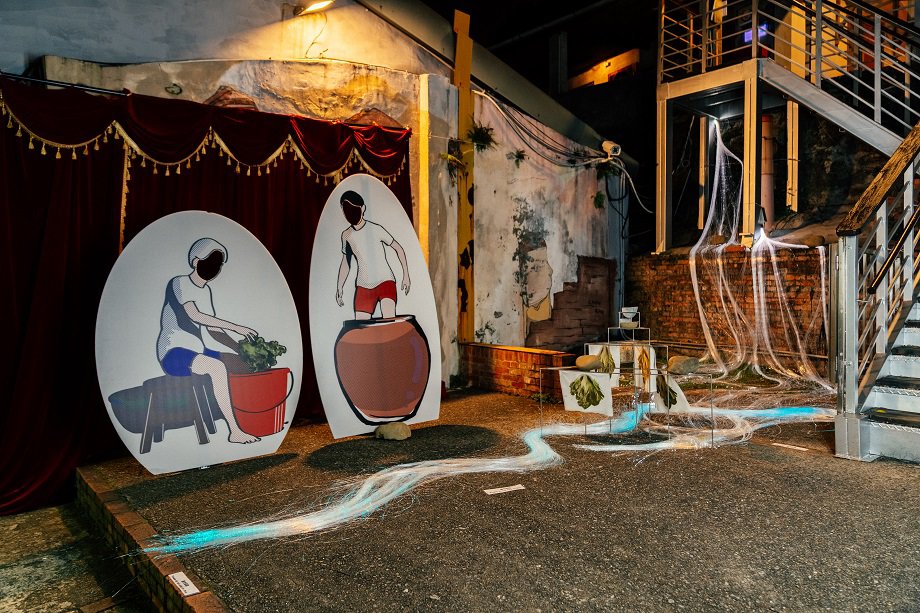
  • Yong-Jin Chiu,《House Place》— House Place (Vuk-congˇ) serves as a generative starting point. Through the progressive addition of side houses (Vangˇ-vuk), it matures into a 'Fo-fongˇ'—a traditional multi-generational compound that preserves the lineage's historical trajectory.

  • Nai-Ren Chang,《qimˇ miˊ》—  Centered on the concept of the 'Voˇ-chinˇ'—the traditional drying harvest courtyard—it transforms the city's spaces and cultural legacy into an artistic showcase.

Artwork at Container House (水源213)

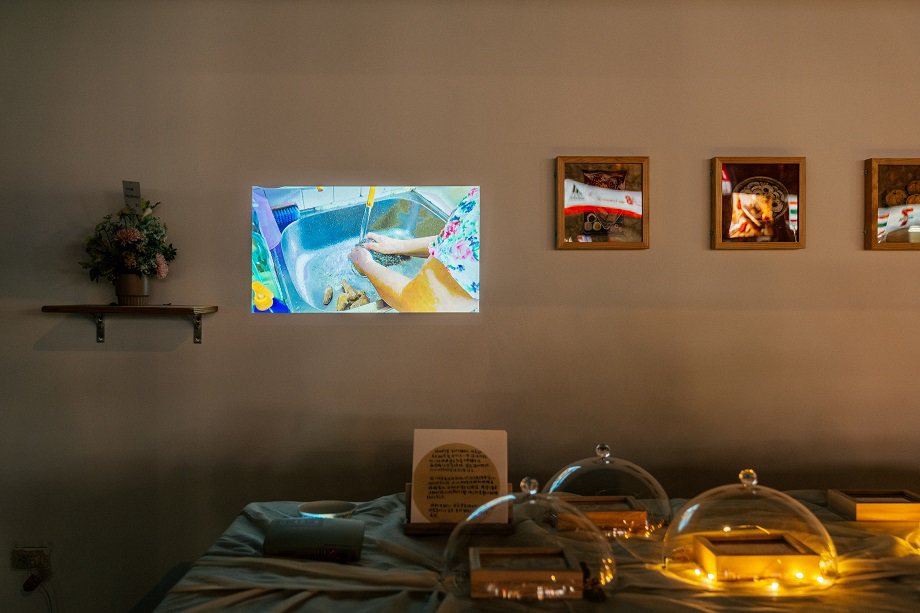
  • Sylvia C. Y. Yang,《Let's Cook “Ban” Today : In the Evening》— In Taipei’s Cheng-Nan area, a rare social scene is recreated: Hakka women gather to make the rice delicacy ban. By documenting the process and their conversations, the project traces the pathways of Hakka migration into the Cheng-Nan area and the social networks shaped by culinary traditions. More than just a dish, ban carries the personal stories and intimate emotions of Hakka women. The artist transforms these interactions and fieldwork narratives into an installation, presenting the first post-pandemic on-site exhibition, Let’s Cook “Ban” Today: In the Evening, which will radiate warmth and genuine connections from the container pavilion at Shuiyuan Market.


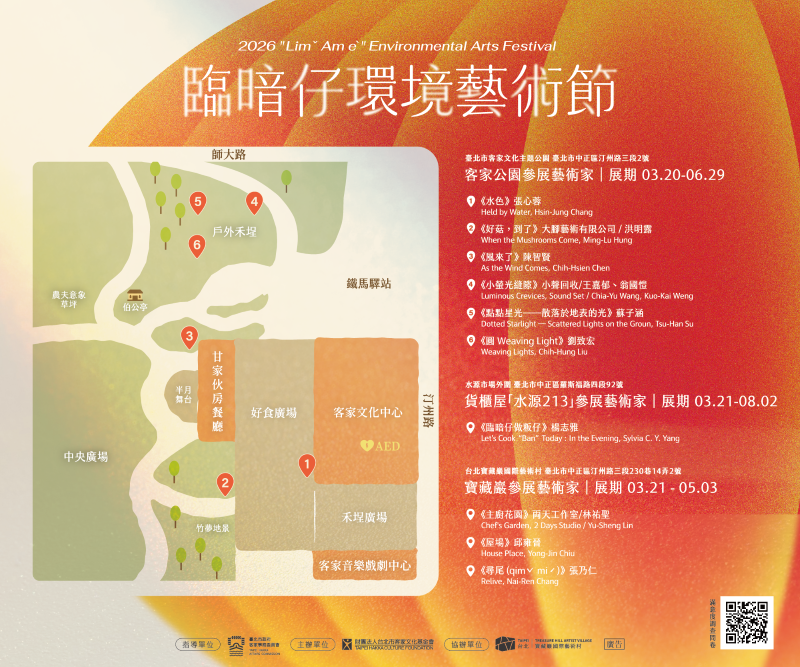
Map of 2026 "Limˇ Am eˋ" Environmental Arts Festival at Taipei City Hakka Cultural Park

Back